Sunday, August 24, 2003

Word of the Day


gobelin


The oldest picture carpets originate however from Egypt (1400 v.Ch.)

Later, starting from the time 14. Century was used then also different materials, like for example silk, and the function of the thermic protection was omitted. Also the motives, in the Middle Ages strictly simplified, became more playful and the art of the Stickens achieved their full bloom in 16. Jh. however not only in France, but also in Flanders (you think only times of the mad point work from Brussels), Italy and Germany was well-known the Sticken and likes.

The name Gobelin as synonym for the art of the hand ticking descends from the French family of the same name, which possessed into of Paris a famous manufacture for the production of Gobelins.

After a period of regress, at the beginning of the XXth century the tapestry rose again through a spectacular turning point in its evolution.

The needlework in form of Gobelin has developed and got a broader use, being present as a decorative element in paintings, framed in fancy works, pillows of adornment, jeweler’s baskets.

Friday, August 22, 2003

Word of the Day


spurtle, spurkle Northern, Central 1 a long-handled, flat-bladed implement for turning oatcakes, scones etc now West Angus, Perth. 2 a short tapering stick for stirring porridge, soup etc General but rare in Angus.

Sunday, August 10, 2003

Vocabulary List for "Necromancy in Naat"


bale


\Bale\ (b[=a]l), n. [AS. bealo, bealu, balu; akin to OS. balu, OHG. balo, Icel. b["o]l, Goth. balweins.] 1. Misery; calamity; misfortune; sorrow.

Let now your bliss be turned into bale. --Spenser.

2. Evil; an evil, pernicious influence; something causing great injury. [Now chiefly poetic]

Evil: “Tidings of bale she brought” (William Cullen Bryant).
Mental suffering; anguish: “Relieve my spirit from the bale that bows it down” (Benjamin Disraeli).


sanies


n. pl. sanies
A thin, fetid, greenish fluid consisting of serum and pus discharged from a wound, ulcer, or fistula.


anthropophagi


\An`thro*poph"a*gi\, n. pl. [L., fr. Gr. ? eating men; ? man + + ? to eat.] Man eaters; cannibals. --Shak.


wilderment


\Wil"der*ment\, n. The state of being bewildered; confusion; bewilderment.

And snatched her breathless from beneath This wilderment of wreck and death. --Moore.


bewondered


Bewonder \Be*won"der\, v. t. [imp. & p. p. Bewondered.] 1. To fill with wonder. [Obs.]

2. To wonder at; to admire. [Obs.]


debarred


Debar \De*bar"\, v. t. [imp. & p. p. Debarred; p. pr. & vb. n. Debarring.] [Pref. de- + bar.] To cut off from entrance, as if by a bar or barrier; to preclude; to hinder from approach, entry, or enjoyment; to shut out or exclude; to deny or refuse; -- with from, and sometimes with of.

Yet not so strictly hath our Lord imposed Labor, as to debar us when we need Refreshment. --Milton.

Their wages were so low as to debar them, not only from the comforts but from the common decencies of civilized life. --Buckle.


poltroonery


\Pol*troon"er*y\, n. [F. poltronnerie; cf. It. poltroneria.] Cowardice; want of spirit; pusillanimity.


trivet


\Triv"et\, n. [Probably through French fr. L. tripes, -edis, three-footed; tri- (see Tri-)+ pes, pedis, foot: cf. F. tr['e]pied. See Foot, and cf. Tripod.] 1. A tree-legged stool, table, or other support; especially, a stand to hold a kettle or similar vessel near the fire; a tripod. [Written also trevet.]

2. A weaver's knife. See Trevat. --Knight.

Trivet table, a table supported by three legs. --Dryden.

(Here used to mean a three-legged stool.)


serpenting


Serpent \Ser"pent\, v. i. [imp. & p. p. Serpented; p. pr. & vb. n. Serpenting.] To wind like a serpent; to crook about; to meander. [R.] ``The serpenting of the Thames.'' --Evelyn.


wonting


Wont \Wont\, v. i. [imp. Wont, p. p. Wont, or Wonted; p. pr. & vb. n. Wonting.] To be accustomed or habituated; to be used.

A yearly solemn feast she wont to make. --Spenser.


mantic


\Man"tic\, a. [Gr. ? prophetic.] Of or pertaining to divination, or to the condition of one inspired, or supposed to be inspired, by a deity; prophetic. [R.] ``Mantic fury.'' --Trench.


parricides


par·ri·cide ( P ) Pronunciation Key (pr-sd)
n.
The murdering of one's father, mother, or other near relative.
One who commits such a murder.


--------------------------------------------------------------------------------
[Latin parricda, and parricdium pri-, parri-, kin + -cda, -cdium, -cide.]


adjuring


Adjure \Ad*jure"\, v. t. [imp. & p. p. Adjured; p. pr. & vb. n. Adjuring]. [L. adjurare, adjurdium, to swear to; later, to adjure: cf. F. adjurer. See Jury.] To charge, bind, or command, solemnly, as if under oath, or under the penalty of a curse; to appeal to in the most solemn or impressive manner; to entreat earnestly.

Joshua adjured them at that time, saying, Cursed be the man before the Lord, that riseth up and buildeth this city Jericho. --Josh. vi. 26.

The high priest . . . said . . . I adjure thee by the living God, that thou tell us whether thou be the Christ. --Matt. xxvi. 63.

The commissioners adjured them not to let pass so favorable an opportunity of securing their liberties. --Marshall.


adjuration


\Ad`ju*ra"tion\, n. [L. adjuratio, fr. adjurare: cf. F. adjuration. See Adjure.] 1. The act of adjuring; a solemn charging on oath, or under the penalty of a curse; an earnest appeal.

What an accusation could not effect, an adjuration shall. --Bp. Hall.

2. The form of oath or appeal.

Persons who . . . made use of prayer and adjurations. --Addison.


aforetime


\A*fore"time`\, adv. In time past; formerly. ``He prayed . . . as he did aforetime.'' --Dan. vi. 10.

The Clark Ashton Smith Vocabulary Builder!


Okay, yesterday I hied my way up to Borderlands Books in San Francisco, to pick up a copy of Clark Ashton Smith's Zothique so I wouldn't have to read the bootlegs on the web or pay silly amounts for a hardback from Arkham House. I wanted a paperback containing all the Zothique stories and nothing else, and that's what Lin Carter edited for Ballantine in 1970. And Borderlands was selling it for the perfectly reasonable price of $6, not silly collectable amounts like all the other stores listing that copy on the web.

Reading the introduction I found myself tenuously connected in the chain of authors. Lin Carter mentioned that Smith had probably met Ambrose Bierce (who wrote "The Children of Hastur" which inspired Robert Chambers and thereby H.P. Lovecraft), and the maps of Zothique were taken from ones done by L. Sprague de Camp and corrected for him by Smith. I met L. Sprague and Catherine de Camp at WorldCon in San Francisco, talking to them for about an hour at a SFWA party. Wonderful people, they passed away a few years ago. Odd to think of the six degrees of separation stretching back in time like that though.

Which has not that much to do with the title of this entry, but having now read the first story in the book, "Xeethra," I'm faced with a new vocabulary list.

Okay, kudos to myself first. I knew all the words in the preface poem here:

Zothique


Clark Ashton Smith

He who has trod the shadows of Zothique
And looked upon the coal-red sun oblique,
Henceforth returns to no anterior land,
But haunts a later coast
Where cities crumble in the black sea-sand
And dead gods drink the brine.

He who has known the gardens of Zothique
Were bleed the fruits torn by the simorgh's beak,
Savors no fruit of greener hemispheres:
In arbors uttermost,
In sunset cycles of the sombering years,
He sips an amaranth wine.

He who has loved the wild girls of Zothique
Shall not come back a gentler love to seek,
Nor know the vampire's from the lover's kiss:
For him the scarlet ghost
Of Lilith from time's last necropolis
Rears amorous and malign.

He who has sailed in galleys of Zothique
And seen the looming of strange spire and peak,
Must face again the sorcerer-sent typhoon,
And take the steerer's post
On far-poured oceans by the shifted moon
Or the re-shapen Sign.


And I also spotted the misprint in the Lin Carter edition, where "amaranth" has been transposed to "aramanth." Amaranth is definitely the word that Smith wants, since here's the dictionary definition:

amaranth


n.
1. Any of various annuals of the genus Amaranthus having dense green or reddish clusters of tiny flowers and including several weeds, ornamentals, and food plants. Also called pigweed.
2. An imaginary flower that never fades.
3. A deep reddish purple to dark or grayish, purplish red.
4. A dark red to purple azo dye.

Also, the simorgh is the dog-headed bird from Persian myth who sometimes lives on Mt. Parnassus.

But, on to the unfamiliar vocabulary and odd usages of "Xeethra." In order:

combe


Comb \Comb\, Combe \Combe\ (? or ?), n. [AS. comb, prob. of Celtic origin; cf. W. cwm a dale, valley.] That unwatered portion of a valley which forms its continuation beyond and above the most elevated spring that issues into it. [Written also coombe.] --Buckland.

A gradual rise the shelving combe Displayed. --Southey.


quoin also coign

( P ) Pronunciation Key (koin, kwoin)
n.

An exterior angle of a wall or other piece of masonry.
Any of the stones used in forming such an angle, often being of large size and dressed or arranged so as to form a decorative contrast with the adjoining walls.
A keystone.
Printing. A wedge-shaped block used to lock type in a chase.
A wedge used to raise the level of a gun.

tr.v. quoined, also coigned quoin·ing, coign·ing quoins, coigns
To provide, secure, or raise with a quoin or quoins.


relume


\Re*lume"\ (r?-l?m"), v. t. [imp. & p. p. Relumed (-l?md"); p. pr. & vb. n. Reluming.] [OF. relumer (cf. F. rallumer), L. reluminare; pref. re- re- + luminare to light. Cf. Reillume.] To rekindle; to light again.

Relumed her ancient light, not kindled new. --Pope.

I know not where is that Promethean heat That can thy light relume. --Shak.


appetence


n : a feeling of craving something; "an appetite for life"; "the object of life is to satisfy as many appetencies as possible"- Granville Hicks


wildered


Wilder \Wil"der\, v. t. [imp. & p. p. Wildered; p. pr. & vb. n. Wildering.] [Akin to E. wild, Dan. forvilde to bewilder, Icel. villr bewildered, villa to bewilder; cf. AS. wildor a wild animal. See Wild, a., and cf. Wilderness.] To bewilder; to perplex.

Long lost and wildered in the maze of fate. --Pope.

Again the wildered fancy dreams Of spouting fountains, frozen as they rose. --Bryant.


covert


\Cov"ert\, n. [OF. See Covert, a.] 1. A place that covers and protects; a shelter; a defense.

A tabernacle . . . for a covert from storm. --Is. iv. 6.

(I'd never seen this as a noun before.)


frontlets


frontlet ( P ) Pronunciation Key (frntlt)
n.
An ornament or band worn on the forehead as a phylactery.
The forehead of an animal.
The forehead of a bird when of a different color or texture of plumage.
An ornamental border for a frontal.


--------------------------------------------------------------------------------
[Middle English, from Old French frontelet, diminutive of frontel, ornament worn on the forehead. See frontal2.]

occurs only in Ex. 13:16; Deut. 6:8, and 11:18. The meaning of the injunction to
the Israelites, with regard to the statues and precepts given them, that they
should "bind them for a sign upon their hand, and have them as frontlets
between their eyes," was that they should keep them distinctly in view and
carefully attend to them. But soon after their return from Babylon they began
to interpret this injunction literally, and had accordingly portions of the law
written out and worn about their person. These they called tephillin, i.e.,
"prayers." The passages so written out on strips of parchment were these, Ex.
12:2-10; 13:11-21; Deut. 6:4-9; 11:18-21. They were then "rolled up in a case
of black calfskin, which was attached to a stiffer piece of leather, having a
thong one finger broad and one cubit and a half long. Those worn on the
forehead were written on four strips of parchment, and put into four little
cells within a square case, which had on it the Hebrew letter called shin, the
three points of which were regarded as an emblem of God." This case tied around
the forehead in a particular way was called "the tephillah on the head." (See
PHYLACTERY.)


wot


Wit \Wit\, v. t. & i. [inf. (To) Wit; pres. sing. Wot; pl. Wite; imp. Wist(e); p. p. Wist; p. pr. & vb. n. Wit(t)ing. See the Note below.] [OE. witen, pres. ich wot, wat, I know (wot), imp. wiste, AS. witan, pres. w[=a]t, imp. wiste, wisse; akin to OFries. wita, OS. witan, D. weten, G. wissen, OHG. wizzan, Icel. vita, Sw. veta, Dan. vide, Goth. witan to observe, wait I know, Russ. vidiete to see, L. videre, Gr. ?, Skr. vid to know, learn; cf. Skr. vid to find. ????. Cf. History, Idea, Idol, -oid, Twit, Veda, Vision, Wise, a. & n., Wot.] To know; to learn. ``I wot and wist alway.'' --Chaucer.


agone


\A*gone"\, a. & adv. Ago. [Archaic> & Poet.]

Three days agone I fell sick. --1 Sam. xxx. 13.


senescence


\Se*nes"cence\, n. [See Senescent.] The state of growing old; decay by time.


objurgation


\Ob`jur*ga"tion\, n. [L. objurgatio: cf.F. objurgation.] The act of objurgating; reproof.

While the good lady was bestowing this objurgation on Mr.Ben Allen. --Dickens.

With a strong objurgation of the elbow in his ribs. --Landor.


unceremented


This appears to be an original coinage by Clark Ashton. The meaning is clear: cerements are the wrappings of a mummy. Unceremented would then mean "unwrapped," in a particularly poetic form specific to mummies (or maybe anyone with a winding sheet), with shades of meaning of "desecrated," since cerements are put on with ceremony, and to undo a ceremony would be a desecration. Besides "Xeethra," he also uses the word in the poem:

The Medusa of the Skies

Clark Ashton Smith

Like a worm-fretted visage from the tomb,
The moon unswathes her hollow, shrunken head,
Launching such light as foulders on the dead
From pallid skies more death-like than the gloom.
Under her beams the breasted lands assume
Dead hues, and charnel shapes unceremented;
And shadows that towering sepulchers might shed
Move livid as the shadows on dials of doom.

On hills like tumuli, and waters mute,
A whiteness steals as of a world made still
When reptant Death at last rears absolute—
An earth now frozen by malefice of eyes
Aeonian dooms and realm-deep rigors fill—
The gaze of that Medusa of the skies.

[Aside: Vocabulary for this poem....

foulder


\Foul"der\, v. i. [OE. fouldre lightning, fr. F. foudre, OF. also fouldre, fr. L. fulgur. See Fulgor.] To flash, as lightning; to lighten; to gleam; to thunder. [Obs.] ``Flames of fouldering heat.'' --Spenser.


tumuli


Tumulus \Tu"mu*lus\, n.; pl. Tumuli. [L., a mound, a sepulchral mound, probably from tumere to swell. Cf. Tumid.] An artificial hillock, especially one raised over a grave, particularly over the graves of persons buried in ancient times; a barrow.


reptant


\Rep"tant\ (r?p"tant), a. [L. reptans, -antis, p. pr. of reptare, v. intens. from repere to creep. See Reptile.] 1. (Bot.) Same as Repent.

2. (Zo["o]l.) Creeping; crawling; -- said of reptiles, worms, etc.


malefice


\Mal"e*fice\, n. [L. maleficium: cf. F. mal['e]fice. See Malefactor.] An evil deed; artifice; enchantment. [Obs.]


We now return you to your regularly scheduled vocabulary list....


massy


\Mass"y\, a. [Compar. Massier; superl. Massiest.] Compacted into, or consisting of, a mass; having bulk and weight ot substance; ponderous; bulky and heavy; weight; heavy; as, a massy shield; a massy rock.

Your swords are now too massy for your strengths, And will not be uplifted. --Shak.

Yawning rocks in massy fragments fly. --Pope.


marmorean


Marmoreal \Mar*mo"re*al\, Marmorean \Mar*mo"re*an\, a. [L. marmoreus, fr. marmor marble: cf. F. marmor['e]en. See Marble.] Pertaining to, or resembling, marble; made of marble.


whelmed


Whelm \Whelm\, v. t. [imp. & p. p. Whelmed; p. pr. & vb. n. Whelming.] [OE. whelmen to turn over, akin to OE. whelven, AS. whelfan, hwylfan, in ?whylfan, ?whelfan, to overwhelm, cover over; akin to OS. bihwelbian, D. welven to arch, G. w["o]lben, OHG. welben, Icel. hvelfa to overturn; cf. Gr. ? bosom, a hollow, a gulf.] 1. To cover with water or other fluid; to cover by immersion in something that envelops on all sides; to overwhelm; to ingulf.

She is my prize, or ocean whelm them all! --Shak.

The whelming billow and the faithless oar. --Gay.

2. Fig.: To cover completely, as if with water; to immerse; to overcome; as, to whelm one in sorrows. ``The whelming weight of crime.'' --J. H. Newman.

3. To throw (something) over a thing so as to cover it. [Obs.] --Mortimer.


satiety


\Sa*ti"e*ty\, n. [L. satietas, from satis, sat, enough: cf. F. sati['e]t['e].] The state of being satiated or glutted; fullness of gratification, either of the appetite or of any sensual desire; fullness beyond desire; an excess of gratification which excites wearisomeness or loathing; repletion; satiation.

In all pleasures there is satiety. --Hakewill.

But thy words, with grace divine Imbued, bring to their sweetness no satiety. --Milton.

Syn: Repletion; satiation; surfeit; cloyment.


woful


Woeful \Woe"ful\, Woful \Wo"ful\, a. 1. Full of woe; sorrowful; distressed with grief or calamity; afflicted; wretched; unhappy; sad.

How many woeful widows left to bow To sad disgrace! --Daniel.

2. Bringing calamity, distress, or affliction; as, a woeful event; woeful want.

O woeful day! O day of woe! --Philips.

3. Wretched; paltry; miserable; poor.

What woeful stuff this madrigal would be! --Pope.

(Knew the word, but not this spelling.)


troublous


\Trou"blous\, a. Full of trouble; causing trouble. ``In doubtful time of troublous need.'' --Byron.

A tall ship tossed in troublous seas. --Spenser.


bourn


\Bourn\, Bourne \Bourne\, n. [F. borne. See Bound a limit.] A bound; a boundary; a limit. Hence: Point aimed at; goal.

Where the land slopes to its watery bourn. --Cowper.

The undiscovered country, from whose bourn No traveler returns. --Shak.

Sole bourn, sole wish, sole object of my song. --Wordsworth.

To make the doctrine . . . their intellectual bourne. --Tyndall.


guerdon


\Guer"don\, n. [OF. guerdon, guerredon, LL. widerdonum (influenced by L. donum gift, cf. Donation ), fr. OHG. widarl[=o]n; widar again, against (G. wider wieder) + l[=o]n reward, G. lohn, akin to AS. le['a]n Goth. laun. See Withers.] A reward; requital; recompense; -- used in both a good and a bad sense. --Macaulay.

So young as to regard men's frown or smile As loss or guerdon of a glorious lot. --Byron.

He shall, by thy revenging hand, at once receive the just guerdon of all his former villainies. --Knolles.


mufti


\Muf"ti\, n. Citizen's dress when worn by a naval or military officer; -- a term derived from the British service in India. [Colloq. Eng.]


recreancy


\Rec"re*an*cy\ (-an*s?), n. The quality or state of being recreant.


(Recreant I knew from "Rowan the Recreant," from Elizabeth Scarborough's The Christening Quest)

Saturday, August 09, 2003

Words, words, words! I'm so sick of words!


Actually, no, I'm not, but sometimes you go into overload. As, for example, when you find a glossary like this one:


http://www.mewslade.freeserve.co.uk/glossary.htm

Glossary.

Acre: customary acre larger than a standard acre of 4840 sq.yds.
Andirons: firedogs to hold spits for roasting meat. Support for the grate.
Arras: a rich tapestry fabric. Originating in Arras, Flanders.
Arminians: o riginally the followers of a Dutch theologian called Arminius. They believed
all were offered salvation, not just the Elect, and could work out their own salvation and
were reacting against the Reformation.
Artisan: skilled worker. Used here as a craftsman or shepherd.
Awn: prickley bristle at the top of the barley grain's sheath.
Backside : area or yard behind a house.
Barrel: these stored butter, beer, fish, salt or wines (qv firkin).
Batter: a walls receding slope from ground upwards.
Bay: space between main roof supports.
Bays: a fine lightweight cloth.
Beam : a scale which could be used for weighing fleeces.
Bed : referred to the mattress.
Bedsted/ Bedstead : bed frame.
Black- jack jug : a leather jug
Board cloth : table cloth.
Bole: special alcove in a wall for a hive. A bolle was a container for honey and thick liquids
Boulting tub or hutch : container to sieve flour into (p664).
Bond : deed by which a person binds himself to pay another.
Brandiron : (1) a branding iron for stock. (2) a gridiron.
Bressumer : horizontal timber carrying a wall. The lintel supporting the chimney over the inglenook.
Brogger : a factor who acted as middleman between sheep-breeders and the clothiers who
needed raw wool to make cloth.
Bushel : measure of corn (Appendix 2). 8 bushels in a quarter.
Butt : measure of land equal to a rood.
Calkins : end parts of a horseshoe turned up and then sharpened to prevent the horse slipping.
Capon : a castrated cock for eating.
Card: iron-toothed instrument for combing out wool or flax.
Carpet : cover for wall, table and other furniture.
Cartload : a measure for coal, faggots, hay, lime and straw.
Cast : when the cow has the calf prematurely.
Caudle : Warm gruel with spice, sugar, and wine, for invalids.
Chirurgeon: one who operates with the hand. Rede [32] then combined surgery with his
barber's shop. The striping on a barber's pole represented the ribbon round the arm of
a person, who was having his blood let. Some thought of them as low practitioners of surgery.
Cimer: a vessel for making dough in?
Page 717

Cloome: cloam: usually oxen or horse dung.
Close: enclosed piece of land, in this period next to the house.
Clove: 7 lbs of wool was equal to a clove. 4 cloves made 1 todd.
Coney : a rabbit.
Coopery ware : "cowpery ware" mostly tubs, casks etc for brewing. Made by a cooper.
Corvisor/ cordwainer : a shoemaker.
Cowl/coul : a cooler, a large wooden tub for brewing.
Coulter : a vertical iron cutting blade. This is fixed to the front of the ploughshare.
Curb: wall, or edge round the well.
Cut: woollen carded 1 cut giving approximately 300 yds single ply wool per lb.
Damask : a patterned linen imitating silks woven at Damascus (p649).
Danske chest : a foreign chest (Danish).
Demesne : land attached to the manor farm.
Diaper : a system of weaving small twill patterns using unbleached threads for napkins.
Doale: dole or lot meadow. Shared out every year.
Ear[th] : to plough and destroy weeds.
Ell : measure for linen and haircloth equal to 45 inches.
Ewe : female sheep that has had at least one lamb.
Ewe-crone : an old barren ewe.
Ewe-lamb: (gimmer or chiver) female lamb up to weaning.
Ewe-teg : (gimmer hog, ewe hog) weaning up to first shearing.
Exhibited : The inventory presented at the church court with the will.
Face cloath : women used them when riding out.
Family : The people in a household (qv) who are related by blood and marriage.
Fetter : D- shaped shackle for tethering a horse by the leg.
Firebote : the wood or rough ground granted to the tenants by the lord of the manor for
the purpose of gathering fuel.
Firkin: small butter barrel, half a hundredweight. A liquid measure for beer of 9 gallons.
Flasket : (1) a shallow washing tub. (2) Shallow basket.
Flaxen: cloth made from a lower quality linen (flax) thread.
Flitches : sides of bacon.
Foremilch : a cow not yet in milk.
Forke : the crutch part of a garment.
Frame : joined table frame fixed to table board.
Frieze : coarse woollen cloth with nap usually on one side only.
Furnace : for brewing.
Gals/Gyles : girls.
Garner : a container to store grain or malt.
Hackles of straw : long pieces of straw resembling the long feathers on the neck of a cock.
Spreading out like a protective tent to keep the bee skep dry.
Hadelay : A narrow piece of land left as leyland. Hades: leyland.
Haulm : dry stems of peas (minus the peas) for fodder.
"The haulm is the straw of the wheat or the rye,
which once being reaped, they mow by and by..." Tusser.
Long straw left on the field, minus corn, to be cut later. Rye straw (haulme) was needed
for thatching after first removing the leaves and cutting off the ears.
Page 718

Hayding: alongside another furlong.
Heifer : young cow expecting her first calf.
Hempen: using thread spun from hemp.
Heriot: best beast, or value in money, owed to landlord after death of a tenant.
Hilling : A cover for the bed.
Hoggerells: two year old ewes.
Hogshead : barrel holding 54 gallons of beer.
Holland: unbleached linen cloth woven from high quality thread (p649).
Homestall : farm and yard.
Horse gears: harness.
Horse locks: locks for the fetters (q.v).
Household : all those who live under one roof, and owe allegiance to the master, or if a
widow to the mistress. Includes wife, relations, servants and children.
Houseled : to receive the sacrament. As man and wife were counted as one this could give
the number of households, except it does not include all the adults in the house.
Housewright : Organised the building of a house.
Humnel stick : used to soften the awns on barley which are sharp.
Impropriator : a layman who has taken over tithes once reserved for clergy. In this case
the rectorial or great tithes.
"Joyned bedsted"/Joined bedstead : a four poster with a canopy or tester made by a joiner.
Journeyman : qualified artisan who works for a wage.
"Joynture" : estate settlement on a wife for use during widowhood.
Kerseys : a coarse but still lightweight material. Narrower than the broadcloths.
Kiddes : a bundle of faggots.
Kin: Those relations who can lay claim to a particular group. In return they will be expected
to support them and obey their customs.
Kirtle: outer petticoat or gown.
Kiver : a shallow wooden tub.
Kyne : cows.
Land : a strip of arable or ley land equal in Cropredy to half an acre. Two roods.
Lea : 1 lea equals 300 yards single ply linen per lb. (qv Cut and combed wool).
Ley: greensward kept for hay and pasture. Two leys to the acre.
Lead : a vat for brewing.
Light : part of a window division.
Lineagae : all those relations gone before, at present and still to come. Some of which are
represented in the family trees.
Long cart : Had two wheels. A waggon had four.
Long-house-type : barn and house under one roof. Sharing one entrance.
Loom : vessel.
Mark : a coin valued at 13s-4d.
Maslin : usually wheat and rye mixed together.
Midden: dung heap.
Milch cow: a cow yielding milk, or kept for milk.
Mortuary : customary payment to the incumbent upon the death of a parishioner [Tate W.E..
The Parish Chest 1946 Cambridge Univ. Press].
Napery: linen.
Page 719

Neatherd : cowherd. A neat animal was any bovine animal.
Nether house : lower than the hall. Originally made from a bay of a long house barn next to the entry
passage.
New draperies : bays, arras, says and kerseys (qv).
Newel post: centre pillar of a winding stairs.
Noble: gold coin usually worth 6s-8d. With a ship shown on one side it was intended for foreign trade.
Orris : lace with patterns of gold and silver embroidery.
Painted cloth : substitute for tapestry. A cloth painted in oil.
Partition : a wall dividing two rooms.
Petty school : elementary school. Taught reading, religion and discipline.
Pieces : plots of land larger than a strip. Often a collection of strips which remain attached
to one farm.
Piklet or pytel : a small piece of enclosed land, often triangular.
Pillowbere: pillow case.
Pipe : equal to 2 hogsheads or 4 barrels. 105 imperial gallons.
Pleashed : plashing a hedge to lay it and so make it stock proof.
Portal : a partition or screen to keep out some of the draughts.
Posnet : a small metal pot with a handle and three short feet. Used to make a hot drink
curdled with ale or wine. A posset.
Powdering tub : used for salting meat.
Press : (1) for cheese (2) a cupboard.
Quarter: (1) division of Open Field. (2) Eight bushels.
Quartern : a quarter of a yardland.
Ram/ shearing tups : first to second shearing. 2,3,4 shear rams/tups according to the number
of times shorn.
Ram-lamb : (hoggets, hogs) male lamb to first shearing.
Register: Act of Parliament 24 Aug. 1653 the custody of parish registers were entrusted to
the new Parish "Registers" who were not called the Registrar. Ratepayers elected them.
Rendle stone : possibly used to help press the cheese.
Retting: steeping flax in water.
Rood : four roods to the acre.
Satin : broken twill. Originated in China. Weave which produces even and smooth surface
hiding ribbed appearance of twill.
Saucer: a vessel to hold condiments and sauces.
Says : another fine cloth resembling serge. Twilled worsted.
Scaffold : wooden platform standing upon staddle stones to support a rick. Or forming a
loft over stalls.
Scot and lot: a parish tax paid according to ability.
Serge: a twilled woollen cloth, also used as a blanket.
Sherrogg : two year old (and over) wether (qv).
Shippicks: shippon (cowshed) pitchfork? Or shepherd's pitchfork?
Skep hive : a bee hive made of straw.
Skutching: cleaning retted flax.
Small corn: medium quality wheat or maslin.
Soft grains: oats or rye.
Page 720


Specialty : a sealed contract.
Spence: a room for storing food. A larder.
Standing bed : tall bedstead with high head and foot ends joined by a tester.
Stint : limiting, especially the rights of pasture.
Stocks : Bee hives.
Stop : decorated or simple end to a chamfered edge of a house beam.
Stryke/ strike : half a bushel. Revd. Holloway used this measure rather than a bushel. The
strike was a rod which was passed across the container measuring the grain.
Sumptuary (laws) : in this case laws regarding clothes as to who was allowed to wear
particular materials or colours.
Sydling/ sidling : a piece of grassland alongside arable furrows used as leyland.
Table : often just the board to fit on trestles.
Tabby, taffeta : plain weaving.
Tapestry : tabby weaving in mosaic, with loose weft.
Terrier : a description of land giving size, direction of strip, furlong and neighbouring tenant.
By mid seventeenth century the number of bays in the house and farm buildings were added.
Tester : wooden or cloth canopy over bed.
Theal: plank of wood.
Throme cloath : remnant from end piece of cloth.
Ticknall ware : coarse earthenware. Often made at Ticknall in Derbyshire.
Tod/ Todd: 28lb weight, used to measure wool.
Toft: homestead.
Treen : small articles of household equipment made from wood.
Truckle bed: low bed pushed under another bedstead during the day.
Trumpery : items of low value.
Tup : male sheep. A ram.
Tweed: a twilled woollen cloth woven in one ply wool.
Twillie : bed cover made in a twill pattern using unbleached linen thread.
Valence : short curtain round bedstead, or canopy.
Wainscot : wooden panelling round the lower part of a room.
Warden : cooking pear.
Wether/wedder : weaned castrated lamb to first shearing. Shearing wether: first to second shearing.
Whitbaker : baker who uses fine bolted white flour.
Whittaw/ whittawer: (white leather) he prepared hides not with tannin but with alum and
salt in a lime vat (p474).
Whorl: a spindle weight.
Winnow cloth: cloth used in winnowing, or to cover windows.
Woollen wheel : for spinning wool.
Worsted: combed wool. 560 yds per lb.
Yardland : measure of land. Average number of acres in Cropredy being 32a 2r (p296).
Yeeling tub : a brewing vat.
Yerd : three roods. Three quarters of an acre.

Another Word of the Day


antependium


an·te·pen·di·um ( P ) Pronunciation Key (nt-pnd-m)
n. pl. an·te·pen·di·a (-d-)
A decorative hanging for the front of an altar, lectern, or pulpit.


--------------------------------------------------------------------------------
[Medieval Latin : Latin ante-, ante- + pendre, to hang; see (s)pen- in Indo-European Roots.]


\An`te*pen"di*um\, n. [LL., fr. L. ante + pendere to hang.] (Eccl.) The hangings or screen in front of the altar; an altar cloth; the frontal. --Smollett.
While looking for pictures for sendal, I came across this word on an Everquest page, of all places.

Word of the Day


urticate ( P ) Pronunciation Key (ûrt-kt)
v. ur·ti·cat·ed, ur·ti·cat·ing, ur·ti·cates
v. tr.
To sting or whip with or as if with nettles.

v. intr.
To produce a stinging or itching sensation.

adj. (-kt, -kt)
Characterized by the presence of hives.


--------------------------------------------------------------------------------
[Medieval Latin urticre, urtict-, from Latin urtica, nettle.]

Friday, August 08, 2003

Alrighty then, the old Word of the Day feature is about to go into overdrive. Why, gentle reader? Well, because as a professional author, I feel it best to humble myself by displaying my ignorance of the words I'm having to look up. And I've just decided to read Clark Ashton Smith's "The Black Abbot of Puthuum."

Yes, I'm reading it. Yes, I'm enjoying it. Yes, I'm consulting the dictionary. Some were words I could parse from context or break out the meanings from the individual roots or knowledge of similar words, but all were ones I'd never read, or seen in these exact forms, or used in these particular senses, before now.

Smith was a poet, and there is a lot of poetic language here.

Here, in order, your vocabulary list for the day:

verdurous


\Ver"dur*ous\, a. Covered with verdure; clothed with the fresh green of vegetation; verdured; verdant; as, verdurous pastures. --Milton.

cataphract


\Cat"a*phract\, n. [L. cataphractes, Gr. ?, fr. ? covered, fr. ? to cover; kata` down, wholly + ? to inclose.] 1. (Mil. Antiq.) Defensive armor used for the whole body and often for the horse, also, esp. the linked mail or scale armor of some eastern nations.

2. A horseman covered with a cataphract.

Archers and slingers, cataphracts, and spears. --Milton.

3. (Zo["o]l.) The armor or plate covering some fishes.

sendal


sen·dal ( P ) Pronunciation Key (sndl)
n.
A thin light silk used in the Middle Ages for fine garments, church vestments, and banners.

[Middle English cendal, from Old French, ultimately from Greek sindn, fine linen.]

\Sen"dal\, n. [OF. cendal (cf. Pr. & Sp. cendal, It. zendale), LL. cendallum, Gr. ??? a fine Indian cloth.] A light thin stuff of silk. [Written also cendal, and sendal.] --Chaucer.

Wore she not a veil of twisted sendal embroidered with silver? --Sir W. Scott.

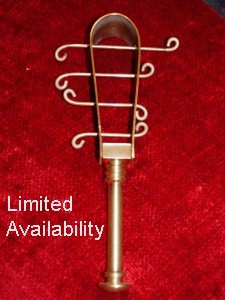
sistra


sis·trum ( P ) Pronunciation Key (sstrm)
n. pl. sis·trums or sis·tra (-tr)
A percussion instrument of ancient Egypt, Sumeria, and Rome consisting of metal rods or loops attached to a metal frame.


--------------------------------------------------------------------------------
[Middle English, from Latin sstrum, from Greek seistron, from seiein, to shake.]


trow


\Trow\, v. i. & t. [OE. trowen, AS. tre['o]wan to trust, believe, fr. tre['o]w trust, tre['o]we true, faithful. See True.] To believe; to trust; to think or suppose. [Archaic]

So that ye trow in Christ, and you baptize. --Chaucer.

A better priest, I trow, there nowhere none is. --Chaucer.

It never yet was worn, I trow. --Tennyson.

Note: I trow, or trow alone, was formerly sometimes added to questions to express contemptuous or indignant surprise.

What tempest, I trow, threw this whale . . . ashore? --Shak.

What is the matter, trow? --Shak.


nictitation


\Nic`ti*ta"tion\, n. The act of winking.

adumbration


\Ad`um*bra"tion\, n. [L. adumbratio.] 1. The act of adumbrating, or shadowing forth.

2. A faint sketch; an outline; an imperfect portrayal or representation of a thing.

Elegant adumbrations of sacred truth. --Bp. Horsley.

3. (Her.) The shadow or outlines of a figure.


arras


\Ar"ras\, n. [From Arras the capital of Artois, in the French Netherlands.] Tapestry; a rich figured fabric; especially, a screen or hangings of heavy cloth with interwoven figures.

Stateliest couches, with rich arras spread. --Cowper.

Behind the arras I'll convey myself. --Shak.

cachinnation


\Cach`in*na"tion\ (k[a^]k`[i^]n*n[=a]"sh[u^]n), n. [L. cachinnatio, fr. cachinnare to laugh aloud, cf. Gr. kacha`zein.] Loud or immoderate laughter; -- often a symptom of hysterical or maniacal affections.

Hideous grimaces . . . attended this unusual cachinnation. --Sir W. Scott.


quietude


\Qui"e*tude\, n. [L. quietudo: cf. F. qui['e]tude.] Rest; repose; quiet; tranquillity. --Shelley.


howbeit


\How*be"it\, conj. [How + be + it.] Be it as it may; nevertheless; notwithstanding; although; albeit; yet; but; however.

The Moor -- howbeit that I endure him not - Is of a constant, loving, noble nature. --Shak.


pandemonian


Poetic for "demonic." Not in standard dictionaries, but with a literary pedigree:


Verses on the Abolition of the Slave Trade, 1804 by Percival Stockdale, Line 4. "Fell agents of their pandemonian chief;"

hebetude


\Heb"e*tude\, n. [L. hebetudo.] Dullness; stupidity. --Harvey.

n : mental lethargy or dullness

bedrowsed


adj. : sleepy, drowsy. "Yet is the Prophet calm, nor would the cave
Daunt him--if his Companions, now bedrowsed
Outstretched and listless, were by hunger roused" --Wordsworth

buskins


bus·kin ( P ) Pronunciation Key (bskn)
n.
A foot and leg covering reaching halfway to the knee, resembling a laced half boot.

A thick-soled laced half boot worn by actors of Greek and Roman tragedies.
Tragedy, especially that which resembles a Greek tragedy.


--------------------------------------------------------------------------------
[Perhaps alteration (influenced by buckskin), of obsolete French broisequin, small leather boot.]


dubitation


\Du`bi*ta"tion\, n. [L. dubitatio.] Act of doubting; doubt. [R.] --Sir T. Scott.


syenite


\Sy"e*nite\, n. [L. Syenites (sc. lapis), from Syene, Gr. ?.] (Min.) (a) Orig., a rock composed of quartz, hornblende, and feldspar, anciently quarried at Syene, in Upper Egypt, and now called granite. (b) A granular, crystalline, ingeous rock composed of orthoclase and hornblende, the latter often replaced or accompanied by pyroxene or mica. Syenite sometimes contains nephelite (el[ae]olite) or leucite, and is then called nephelite (el[ae]olite) syenite or leucite syenite.

crisping


Crisp \Crisp\, v. t. [imp. & p. p. Crisped (kr?spt); p. pr. & vb. n. Crisping.] [L. crispare, fr. crispus. See Crisp. a. ] 1. To curl; to form into ringlets, as hair, or the nap of cloth; to interweave, as the branches of trees.

2. To cause to undulate irregularly, as crape or water; to wrinkle; to cause to ripple. Cf. Crimp.

The lover with the myrtle sprays Adorns his crisped tresses. --Drayton.

Along the crisped shades and bowers. --Milton.

The crisped brooks, Rolling on orient pearl and sands of gold. --Milton.

3. To make crisp or brittle, as in cooking.


fain


adv.
Happily; gladly: “I would fain improve every opportunity to wonder and worship, as a sunflower welcomes the light” (Henry David Thoreau).
Archaic. Preferably; rather.

adj. Archaic
Ready; willing.
Pleased; happy.
Obliged or required.


longevous


\Lon*ge"vous\, a. [L. longaevus; longus long + aevum lifetime, age. See Long, and Age.] Living a long time; of great age. --Sir T. Browne.


anchorite


Anchoret \An"cho*ret\, Anchorite \An"cho*rite\, n. [F. anachor[`e]te, L. anachoreta, fr. Gr. ?, fr. ? to go back, retire; ? + ? to give place, retire, ? place; perh. akin to Skr. h[=a] to leave. Cf. Anchor a hermit.] One who renounces the world and secludes himself, usually for religious reasons; a hermit; a recluse. [Written by some authors anachoret.]

Our Savior himself . . . did not choose an anchorite's or a monastic life, but a social and affable way of conversing with mortals. --Boyle.


subterrene


\Sub`ter*rene"\, a. [L. subterrenus, equiv. to subterraneus.] Subterraneous. [Obs.]


fledging


Fledge \Fledge\, v. t. & i. [imp. & p. p. Fledged; p. pr. & vb. n. Fledging.] 1. To furnish with feathers; to supply with the feathers necessary for flight.

The birds were not as yet fledged enough to shift for themselves. --L'Estrange.

2. To furnish or adorn with any soft covering.

Your master, whose chin is not yet fledged. --Shak.


captious


\Cap"tious\, a. [F. captieux, L. captiosus. See Caption.] 1. Apt to catch at faults; disposed to find fault or to cavil; eager to object; difficult to please.

A captious and suspicious age. --Stillingfleet.

I am sensible I have not disposed my materials to abide the test of a captious controversy. --Bwike.

2. Fitted to harass, perplex, or insnare; insidious; troublesome.

Captious restraints on navigation. --Bancroft.

Syn: Caviling, carping, fault-finding; censorious; hypercritical; peevish, fretful; perverse; troublesome.

Usage: Captious, caviling, Carping. A captious person is one who has a fault-finding habit or manner, or is disposed to catch at faults, errors, etc., with quarrelsome intent; a caviling person is disposed to raise objections on frivolous grounds; carping implies that one is given to ill-natured, persistent, or unreasonable fault-finding, or picking up of the words or actions of others.

Caviling is the carping of argument, carping the caviling of ill temper. --C. J. Smith.


sortilege


\Sor"ti*lege\, n. [F. sortil[`e]ge, fr. L. sors, sortis, a lot + legere to gather, to select.] The act or practice of drawing lots; divination by drawing lots.

A woman infamous for sortileges and witcheries. --Sir W. Scott.


I'll admit I knew the last one, sortilege, but only because I'd looked it up in the dictionary long ago after finding it in the thesaurus as a synonym for divination. I've never actually read it in a story.

And it's a damn good story too, proper sword and sorcery, and would make a damn fine D&D adventure to boot.

It also has the marvelous quaint political incorrectness of the twenties, where you could actually have black villains, but without revealing too much of the story, the point in the end is that's not the point.