Alrighty then, the old Word of the Day feature is about to go into overdrive. Why, gentle reader? Well, because as a professional author, I feel it best to humble myself by displaying my ignorance of the words I'm having to look up. And I've just decided to read Clark Ashton Smith's "The Black Abbot of Puthuum."
Yes, I'm reading it. Yes, I'm enjoying it. Yes, I'm consulting the dictionary. Some were words I could parse from context or break out the meanings from the individual roots or knowledge of similar words, but all were ones I'd never read, or seen in these exact forms, or used in these particular senses, before now.
Smith was a poet, and there is a lot of poetic language here.
Here, in order, your vocabulary list for the day:
\Ver"dur*ous\, a. Covered with verdure; clothed with the fresh green of vegetation; verdured; verdant; as, verdurous pastures. --Milton.

\Cat"a*phract\, n. [L. cataphractes, Gr. ?, fr. ? covered, fr. ? to cover; kata` down, wholly + ? to inclose.] 1. (Mil. Antiq.) Defensive armor used for the whole body and often for the horse, also, esp. the linked mail or scale armor of some eastern nations.
2. A horseman covered with a cataphract.
Archers and slingers, cataphracts, and spears. --Milton.
3. (Zo["o]l.) The armor or plate covering some fishes.
sen·dal ( P ) Pronunciation Key (sndl)
n.
A thin light silk used in the Middle Ages for fine garments, church vestments, and banners.
[Middle English cendal, from Old French, ultimately from Greek sindn, fine linen.]
\Sen"dal\, n. [OF. cendal (cf. Pr. & Sp. cendal, It. zendale), LL. cendallum, Gr. ??? a fine Indian cloth.] A light thin stuff of silk. [Written also cendal, and sendal.] --Chaucer.
Wore she not a veil of twisted sendal embroidered with silver? --Sir W. Scott.
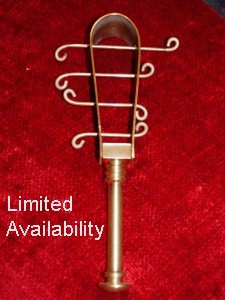
sis·trum ( P ) Pronunciation Key (sstrm)
n. pl. sis·trums or sis·tra (-tr)
A percussion instrument of ancient Egypt, Sumeria, and Rome consisting of metal rods or loops attached to a metal frame.
--------------------------------------------------------------------------------
[Middle English, from Latin sstrum, from Greek seistron, from seiein, to shake.]
\Trow\, v. i. & t. [OE. trowen, AS. tre['o]wan to trust, believe, fr. tre['o]w trust, tre['o]we true, faithful. See True.] To believe; to trust; to think or suppose. [Archaic]
So that ye trow in Christ, and you baptize. --Chaucer.
A better priest, I trow, there nowhere none is. --Chaucer.
It never yet was worn, I trow. --Tennyson.
Note: I trow, or trow alone, was formerly sometimes added to questions to express contemptuous or indignant surprise.
What tempest, I trow, threw this whale . . . ashore? --Shak.
What is the matter, trow? --Shak.
\Nic`ti*ta"tion\, n. The act of winking.
\Ad`um*bra"tion\, n. [L. adumbratio.] 1. The act of adumbrating, or shadowing forth.
2. A faint sketch; an outline; an imperfect portrayal or representation of a thing.
Elegant adumbrations of sacred truth. --Bp. Horsley.
3. (Her.) The shadow or outlines of a figure.
\Ar"ras\, n. [From Arras the capital of Artois, in the French Netherlands.] Tapestry; a rich figured fabric; especially, a screen or hangings of heavy cloth with interwoven figures.
Stateliest couches, with rich arras spread. --Cowper.
Behind the arras I'll convey myself. --Shak.
\Cach`in*na"tion\ (k[a^]k`[i^]n*n[=a]"sh[u^]n), n. [L. cachinnatio, fr. cachinnare to laugh aloud, cf. Gr. kacha`zein.] Loud or immoderate laughter; -- often a symptom of hysterical or maniacal affections.
Hideous grimaces . . . attended this unusual cachinnation. --Sir W. Scott.
\Qui"e*tude\, n. [L. quietudo: cf. F. qui['e]tude.] Rest; repose; quiet; tranquillity. --Shelley.
\How*be"it\, conj. [How + be + it.] Be it as it may; nevertheless; notwithstanding; although; albeit; yet; but; however.
The Moor -- howbeit that I endure him not - Is of a constant, loving, noble nature. --Shak.
Poetic for "demonic." Not in standard dictionaries, but with a literary pedigree:
Verses on the Abolition of the Slave Trade, 1804 by Percival Stockdale, Line 4. "Fell agents of their pandemonian chief;"
\Heb"e*tude\, n. [L. hebetudo.] Dullness; stupidity. --Harvey.
n : mental lethargy or dullness
adj. : sleepy, drowsy. "Yet is the Prophet calm, nor would the cave
Daunt him--if his Companions, now bedrowsed
Outstretched and listless, were by hunger roused" --Wordsworth
bus·kin ( P ) Pronunciation Key (bskn)
n.
A foot and leg covering reaching halfway to the knee, resembling a laced half boot.
A thick-soled laced half boot worn by actors of Greek and Roman tragedies.
Tragedy, especially that which resembles a Greek tragedy.
--------------------------------------------------------------------------------
[Perhaps alteration (influenced by buckskin), of obsolete French broisequin, small leather boot.]
\Du`bi*ta"tion\, n. [L. dubitatio.] Act of doubting; doubt. [R.] --Sir T. Scott.
\Sy"e*nite\, n. [L. Syenites (sc. lapis), from Syene, Gr. ?.] (Min.) (a) Orig., a rock composed of quartz, hornblende, and feldspar, anciently quarried at Syene, in Upper Egypt, and now called granite. (b) A granular, crystalline, ingeous rock composed of orthoclase and hornblende, the latter often replaced or accompanied by pyroxene or mica. Syenite sometimes contains nephelite (el[ae]olite) or leucite, and is then called nephelite (el[ae]olite) syenite or leucite syenite.
Crisp \Crisp\, v. t. [imp. & p. p. Crisped (kr?spt); p. pr. & vb. n. Crisping.] [L. crispare, fr. crispus. See Crisp. a. ] 1. To curl; to form into ringlets, as hair, or the nap of cloth; to interweave, as the branches of trees.
2. To cause to undulate irregularly, as crape or water; to wrinkle; to cause to ripple. Cf. Crimp.
The lover with the myrtle sprays Adorns his crisped tresses. --Drayton.
Along the crisped shades and bowers. --Milton.
The crisped brooks, Rolling on orient pearl and sands of gold. --Milton.
3. To make crisp or brittle, as in cooking.
adv.
Happily; gladly: “I would fain improve every opportunity to wonder and worship, as a sunflower welcomes the light” (Henry David Thoreau).
Archaic. Preferably; rather.
adj. Archaic
Ready; willing.
Pleased; happy.
Obliged or required.
\Lon*ge"vous\, a. [L. longaevus; longus long + aevum lifetime, age. See Long, and Age.] Living a long time; of great age. --Sir T. Browne.
Anchoret \An"cho*ret\, Anchorite \An"cho*rite\, n. [F. anachor[`e]te, L. anachoreta, fr. Gr. ?, fr. ? to go back, retire; ? + ? to give place, retire, ? place; perh. akin to Skr. h[=a] to leave. Cf. Anchor a hermit.] One who renounces the world and secludes himself, usually for religious reasons; a hermit; a recluse. [Written by some authors anachoret.]
Our Savior himself . . . did not choose an anchorite's or a monastic life, but a social and affable way of conversing with mortals. --Boyle.
\Sub`ter*rene"\, a. [L. subterrenus, equiv. to subterraneus.] Subterraneous. [Obs.]
Fledge \Fledge\, v. t. & i. [imp. & p. p. Fledged; p. pr. & vb. n. Fledging.] 1. To furnish with feathers; to supply with the feathers necessary for flight.
The birds were not as yet fledged enough to shift for themselves. --L'Estrange.
2. To furnish or adorn with any soft covering.
Your master, whose chin is not yet fledged. --Shak.
\Cap"tious\, a. [F. captieux, L. captiosus. See Caption.] 1. Apt to catch at faults; disposed to find fault or to cavil; eager to object; difficult to please.
A captious and suspicious age. --Stillingfleet.
I am sensible I have not disposed my materials to abide the test of a captious controversy. --Bwike.
2. Fitted to harass, perplex, or insnare; insidious; troublesome.
Captious restraints on navigation. --Bancroft.
Syn: Caviling, carping, fault-finding; censorious; hypercritical; peevish, fretful; perverse; troublesome.
Usage: Captious, caviling, Carping. A captious person is one who has a fault-finding habit or manner, or is disposed to catch at faults, errors, etc., with quarrelsome intent; a caviling person is disposed to raise objections on frivolous grounds; carping implies that one is given to ill-natured, persistent, or unreasonable fault-finding, or picking up of the words or actions of others.
Caviling is the carping of argument, carping the caviling of ill temper. --C. J. Smith.
\Sor"ti*lege\, n. [F. sortil[`e]ge, fr. L. sors, sortis, a lot + legere to gather, to select.] The act or practice of drawing lots; divination by drawing lots.
A woman infamous for sortileges and witcheries. --Sir W. Scott.
I'll admit I knew the last one, sortilege, but only because I'd looked it up in the dictionary long ago after finding it in the thesaurus as a synonym for divination. I've never actually read it in a story.
And it's a damn good story too, proper sword and sorcery, and would make a damn fine D&D adventure to boot.
It also has the marvelous quaint political incorrectness of the twenties, where you could actually have black villains, but without revealing too much of the story, the point in the end is that's not the point.
Yes, I'm reading it. Yes, I'm enjoying it. Yes, I'm consulting the dictionary. Some were words I could parse from context or break out the meanings from the individual roots or knowledge of similar words, but all were ones I'd never read, or seen in these exact forms, or used in these particular senses, before now.
Smith was a poet, and there is a lot of poetic language here.
Here, in order, your vocabulary list for the day:
verdurous
\Ver"dur*ous\, a. Covered with verdure; clothed with the fresh green of vegetation; verdured; verdant; as, verdurous pastures. --Milton.
cataphract
\Cat"a*phract\, n. [L. cataphractes, Gr. ?, fr. ? covered, fr. ? to cover; kata` down, wholly + ? to inclose.] 1. (Mil. Antiq.) Defensive armor used for the whole body and often for the horse, also, esp. the linked mail or scale armor of some eastern nations.
2. A horseman covered with a cataphract.
Archers and slingers, cataphracts, and spears. --Milton.
3. (Zo["o]l.) The armor or plate covering some fishes.
sendal
sen·dal ( P ) Pronunciation Key (sndl)
n.
A thin light silk used in the Middle Ages for fine garments, church vestments, and banners.
[Middle English cendal, from Old French, ultimately from Greek sindn, fine linen.]
\Sen"dal\, n. [OF. cendal (cf. Pr. & Sp. cendal, It. zendale), LL. cendallum, Gr. ??? a fine Indian cloth.] A light thin stuff of silk. [Written also cendal, and sendal.] --Chaucer.
Wore she not a veil of twisted sendal embroidered with silver? --Sir W. Scott.
sistra
sis·trum ( P ) Pronunciation Key (sstrm)
n. pl. sis·trums or sis·tra (-tr)
A percussion instrument of ancient Egypt, Sumeria, and Rome consisting of metal rods or loops attached to a metal frame.
--------------------------------------------------------------------------------
[Middle English, from Latin sstrum, from Greek seistron, from seiein, to shake.]
trow
\Trow\, v. i. & t. [OE. trowen, AS. tre['o]wan to trust, believe, fr. tre['o]w trust, tre['o]we true, faithful. See True.] To believe; to trust; to think or suppose. [Archaic]
So that ye trow in Christ, and you baptize. --Chaucer.
A better priest, I trow, there nowhere none is. --Chaucer.
It never yet was worn, I trow. --Tennyson.
Note: I trow, or trow alone, was formerly sometimes added to questions to express contemptuous or indignant surprise.
What tempest, I trow, threw this whale . . . ashore? --Shak.
What is the matter, trow? --Shak.
nictitation
\Nic`ti*ta"tion\, n. The act of winking.
adumbration
\Ad`um*bra"tion\, n. [L. adumbratio.] 1. The act of adumbrating, or shadowing forth.
2. A faint sketch; an outline; an imperfect portrayal or representation of a thing.
Elegant adumbrations of sacred truth. --Bp. Horsley.
3. (Her.) The shadow or outlines of a figure.
arras
\Ar"ras\, n. [From Arras the capital of Artois, in the French Netherlands.] Tapestry; a rich figured fabric; especially, a screen or hangings of heavy cloth with interwoven figures.
Stateliest couches, with rich arras spread. --Cowper.
Behind the arras I'll convey myself. --Shak.
cachinnation
\Cach`in*na"tion\ (k[a^]k`[i^]n*n[=a]"sh[u^]n), n. [L. cachinnatio, fr. cachinnare to laugh aloud, cf. Gr. kacha`zein.] Loud or immoderate laughter; -- often a symptom of hysterical or maniacal affections.
Hideous grimaces . . . attended this unusual cachinnation. --Sir W. Scott.
quietude
\Qui"e*tude\, n. [L. quietudo: cf. F. qui['e]tude.] Rest; repose; quiet; tranquillity. --Shelley.
howbeit
\How*be"it\, conj. [How + be + it.] Be it as it may; nevertheless; notwithstanding; although; albeit; yet; but; however.
The Moor -- howbeit that I endure him not - Is of a constant, loving, noble nature. --Shak.
pandemonian
Poetic for "demonic." Not in standard dictionaries, but with a literary pedigree:
Verses on the Abolition of the Slave Trade, 1804 by Percival Stockdale, Line 4. "Fell agents of their pandemonian chief;"
hebetude
\Heb"e*tude\, n. [L. hebetudo.] Dullness; stupidity. --Harvey.
n : mental lethargy or dullness
bedrowsed
adj. : sleepy, drowsy. "Yet is the Prophet calm, nor would the cave
Daunt him--if his Companions, now bedrowsed
Outstretched and listless, were by hunger roused" --Wordsworth
buskins
bus·kin ( P ) Pronunciation Key (bskn)
n.
A foot and leg covering reaching halfway to the knee, resembling a laced half boot.
A thick-soled laced half boot worn by actors of Greek and Roman tragedies.
Tragedy, especially that which resembles a Greek tragedy.
--------------------------------------------------------------------------------
[Perhaps alteration (influenced by buckskin), of obsolete French broisequin, small leather boot.]
dubitation
\Du`bi*ta"tion\, n. [L. dubitatio.] Act of doubting; doubt. [R.] --Sir T. Scott.
syenite
\Sy"e*nite\, n. [L. Syenites (sc. lapis), from Syene, Gr. ?.] (Min.) (a) Orig., a rock composed of quartz, hornblende, and feldspar, anciently quarried at Syene, in Upper Egypt, and now called granite. (b) A granular, crystalline, ingeous rock composed of orthoclase and hornblende, the latter often replaced or accompanied by pyroxene or mica. Syenite sometimes contains nephelite (el[ae]olite) or leucite, and is then called nephelite (el[ae]olite) syenite or leucite syenite.
crisping
Crisp \Crisp\, v. t. [imp. & p. p. Crisped (kr?spt); p. pr. & vb. n. Crisping.] [L. crispare, fr. crispus. See Crisp. a. ] 1. To curl; to form into ringlets, as hair, or the nap of cloth; to interweave, as the branches of trees.
2. To cause to undulate irregularly, as crape or water; to wrinkle; to cause to ripple. Cf. Crimp.
The lover with the myrtle sprays Adorns his crisped tresses. --Drayton.
Along the crisped shades and bowers. --Milton.
The crisped brooks, Rolling on orient pearl and sands of gold. --Milton.
3. To make crisp or brittle, as in cooking.
fain
adv.
Happily; gladly: “I would fain improve every opportunity to wonder and worship, as a sunflower welcomes the light” (Henry David Thoreau).
Archaic. Preferably; rather.
adj. Archaic
Ready; willing.
Pleased; happy.
Obliged or required.
longevous
\Lon*ge"vous\, a. [L. longaevus; longus long + aevum lifetime, age. See Long, and Age.] Living a long time; of great age. --Sir T. Browne.
anchorite
Anchoret \An"cho*ret\, Anchorite \An"cho*rite\, n. [F. anachor[`e]te, L. anachoreta, fr. Gr. ?, fr. ? to go back, retire; ? + ? to give place, retire, ? place; perh. akin to Skr. h[=a] to leave. Cf. Anchor a hermit.] One who renounces the world and secludes himself, usually for religious reasons; a hermit; a recluse. [Written by some authors anachoret.]
Our Savior himself . . . did not choose an anchorite's or a monastic life, but a social and affable way of conversing with mortals. --Boyle.
subterrene
\Sub`ter*rene"\, a. [L. subterrenus, equiv. to subterraneus.] Subterraneous. [Obs.]
fledging
Fledge \Fledge\, v. t. & i. [imp. & p. p. Fledged; p. pr. & vb. n. Fledging.] 1. To furnish with feathers; to supply with the feathers necessary for flight.
The birds were not as yet fledged enough to shift for themselves. --L'Estrange.
2. To furnish or adorn with any soft covering.
Your master, whose chin is not yet fledged. --Shak.
captious
\Cap"tious\, a. [F. captieux, L. captiosus. See Caption.] 1. Apt to catch at faults; disposed to find fault or to cavil; eager to object; difficult to please.
A captious and suspicious age. --Stillingfleet.
I am sensible I have not disposed my materials to abide the test of a captious controversy. --Bwike.
2. Fitted to harass, perplex, or insnare; insidious; troublesome.
Captious restraints on navigation. --Bancroft.
Syn: Caviling, carping, fault-finding; censorious; hypercritical; peevish, fretful; perverse; troublesome.
Usage: Captious, caviling, Carping. A captious person is one who has a fault-finding habit or manner, or is disposed to catch at faults, errors, etc., with quarrelsome intent; a caviling person is disposed to raise objections on frivolous grounds; carping implies that one is given to ill-natured, persistent, or unreasonable fault-finding, or picking up of the words or actions of others.
Caviling is the carping of argument, carping the caviling of ill temper. --C. J. Smith.
sortilege
\Sor"ti*lege\, n. [F. sortil[`e]ge, fr. L. sors, sortis, a lot + legere to gather, to select.] The act or practice of drawing lots; divination by drawing lots.
A woman infamous for sortileges and witcheries. --Sir W. Scott.
I'll admit I knew the last one, sortilege, but only because I'd looked it up in the dictionary long ago after finding it in the thesaurus as a synonym for divination. I've never actually read it in a story.
And it's a damn good story too, proper sword and sorcery, and would make a damn fine D&D adventure to boot.
It also has the marvelous quaint political incorrectness of the twenties, where you could actually have black villains, but without revealing too much of the story, the point in the end is that's not the point.
posted by Kevin at 8:32 PM


0 Comments:
Post a Comment
<< Home